

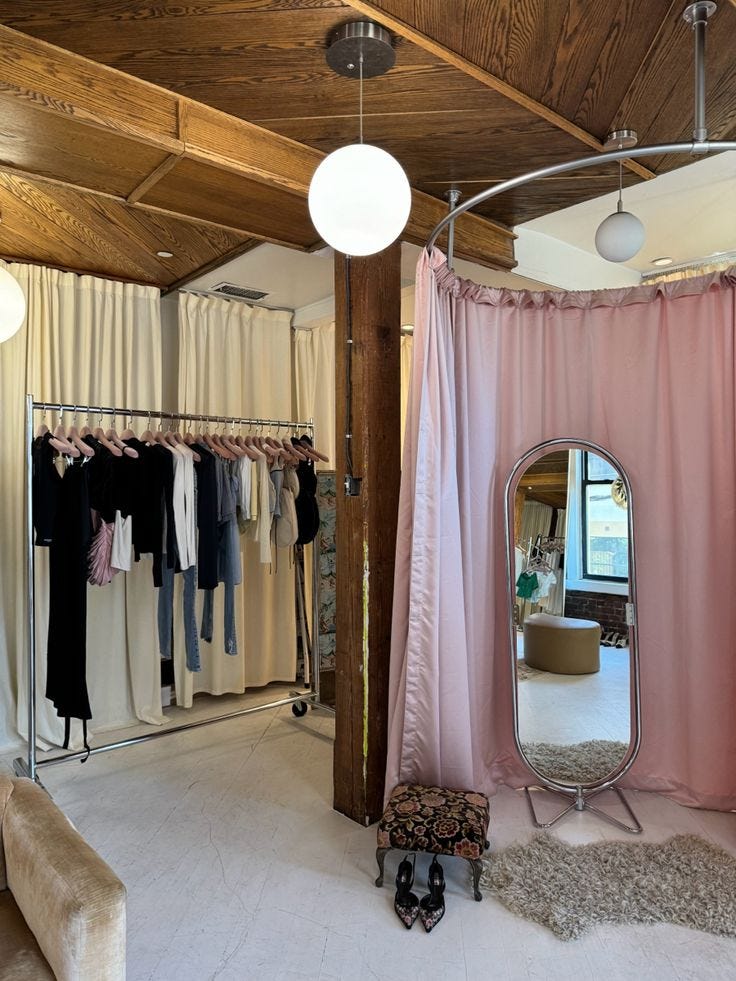
The internet finally got a fitting room. Google is the landlord.
Doppl shutting down is the least interesting thing that happened in fashion tech this week. Here's what actually matters.

1909: Selfridges opens the first fitting room in London. The retail industry calls it reckless. Conversion skyrockets. Within a decade, every department store in the world has one.
2026: Google shuts down Doppl and moves virtual try-on into Search and Shopping. The fashion tech industry calls it a graduation. And somewhere in the coverage, a much bigger announcement gets almost completely missed.
The fitting room didn’t just go mainstream today. It changed owners.
Before Selfridges, you described what you wanted to a clerk and bought it sight unseen. Before virtual try-on, you looked at a flat photo and hoped for the best. Both moments were the industry finally admitting it owed the customer something. The difference is that in 1909, the fitting room belonged to the brand. What Google announced today is a different arrangement entirely.
Here’s what’s actually happening and what the celebration is missing.
Google shut down Doppl — its standalone virtual try-on app — and folded the technology directly into Google Search and Google Shopping. As of today, any product listing with try-on capability shows it natively, one tap, no separate download. And yesterday, Google announced that Google Photos is getting an AI wardrobe feature this summer: it will scan your existing photo library, identify every piece of clothing you’ve ever been photographed wearing, and build you a digital closet — complete with mix-and-match outfit tools and virtual try-on of your own clothes (we’ve heard this story before).
Many outlets today ran the Clueless angle. “Finally, Cher’s virtual wardrobe is real!” It’s a good reference, it’s true, and I get it. But here’s the thing about Cher’s closet that everyone is glossing over: it was Cher’s. She owned it. She controlled it. What Google is building is a closet that lives on Google’s servers, feeds Google’s shopping graph, and routes your customer’s next purchase through Google’s infrastructure. That’s not Clueless. That’s something else entirely.
I use fashion tech and cover it, which means I get to watch the same announcements land differently on two groups of people. The tech side is calling this an infrastructure upgrade. The fashion side is mostly not paying attention yet. Both are missing the actual story. Let me break it down.
What is actually happening here?
Google ran an experiment called Doppl. It worked. Well enough that they didn’t need a separate app anymore. So they absorbed it into the product people already use every day to search and shop. That’s it. That’s the whole move. Google does this constantly: test something standalone, prove the concept, collapse it into Search. It happened with Google Maps, Google Shopping, Google Flights. Virtual try-on is now on that list. The technology graduating isn’t the news. The distribution shift is.
Who does this hurt that the coverage is ignoring?
Two groups. First: independent virtual try-on startups. Companies like AIUTA, Genlook, and Catches have raised real money to solve a real problem. Their pitch has always been “we integrate into your brand’s stack.” But Google’s move doesn’t plug into your stack — it replaces it at the discovery layer for most shoppers. The luxury end is still defensible (Catches is building physics-accurate fabric rendering for brands like Amiri, which is genuinely different from what Google offers). But the mass-market try-on opportunity just got a lot harder.
Second group: indie and mid-market brands that aren't plugged into the Google Shopping ecosystem. If your product listing doesn't support try-on, you are now visually competing against listings that do because your product data isn't structured the way Google's infrastructure needs it to be. That gap is real, it's opening right now, and the trade press is not writing about it from the small brand perspective.
Who benefits, and why are they framing it as consumer empowerment?
Google. Obviously. But the Google Photos wardrobe feature is the part of this week’s news being most underestimated. It’s not try-on for shopping — it’s styling intelligence built from what you already own. Years of clothing choices sitting in your photo library, documented incidentally in birthday photos and vacation selfies. Google hasn’t said how that data will be used. But you don’t build a wardrobe graph at Google’s scale purely as a convenience feature. The pattern is consistent: free tool, useful data, monetization follows.
What does this mean for indie brands versus the big ones?
Enterprise brands already inside the Google Shopping ecosystem get conversion lift immediately. Proof point: Macy’s launched Ask Macy’s in March — an AI shopping assistant built on Google Gemini. In testing, customers who used it spent 4.75 times more per visit than those who didn’t. (Macy’s noted those users arrived with higher purchase intent to begin with — so take the multiplier with appropriate skepticism. The directional signal still stands.)
For indie brands the challenge is structural. Google Shopping integration requires clean product data, accurate imagery, and in many cases an active relationship with Google’s commerce infrastructure. Most small brands haven’t prioritized this because they’ve been thinking about it as a marketing channel. It’s not a marketing channel anymore. It’s the fitting room.
What should actually happen now?
If you’re inside a brand: Google Shopping integration is no longer an ecomm team decision. It’s a company infrastructure decision. Your product data quality, your catalog hygiene, your imagery — these are now the first thing your customer interacts with, before they ever reach your website. The creative director, the tech team, and the ecomm lead need to be in the same room talking about this. Most aren’t.
If you’re an indie brand that can’t win at the Google layer right now: your play is the relationship Google structurally cannot own. The post-purchase moment. Fit memory. The customer who comes back because you knew what she needed before she did. Let Google send you the first sale, genuinely, use their infrastructure for discovery. But build something in the relationship that makes the second sale yours regardless of which platform she found you on. The brands that survive this shift won’t be the ones who out-Googled Google. They’ll be the ones who built something a wardrobe algorithm can’t replicate.
A new job title emerges…
One more thing, and this is the part I like to track and don’t skip over: every shift like this one creates new jobs before the industry has names for them.
What Google announced this week means that every serious fashion brand now needs someone who owns how their products appear, render, and get recommended inside AI-native discovery surfaces. Not your SEO manager. Not your paid media team. The person who understands that your product data is your storefront in a world where the AI is making the first impression.
An “AI Visibility Strategist” role seems to be on the horizon — the person who manages brand presence in AI search, agentic checkout, and virtual try-on results.
The fitting room has always changed hands. From the clerk’s judgment to Selfridge’s curtain. From the physical store to the website to the app. Now to Google.
Each handoff looked like a threat to the brands that had just figured out the last one. Each one turned out to be a new surface to build on.
The industry doesn’t go backward from here. It goes through. And what gets built on the other side of Google’s fitting room is a much bigger opportunity than the one everyone is celebrating today.
But maybe you’re wondering, why now? This next one may answer exactly that:

This was so interesting! Great breakdown. And I totally agree about new jobs - AI Visibility Strategist has a ring to it?