


At the vintage store, a woman holds up a dress to her friend. “It’s beautiful,” she says. “But I’m not a medium anymore.” At the bridal shop, a mother of the bride finds the dress, the one, then goes quiet doing the math on what her body might do in the six months between now and the wedding. At home, it’s my own mother, trying on three things before settling on the one that still, for now, fits the way she remembers.
None of them say the word but they all know what’s underneath it. Menopause, a thing medicine still barely understands, and fashion understands even less.
But menopause is just the clearest example of something bigger. Bodies change. They swell and shrink with stress, medication, pregnancy, illness, time. Yet we treat this as our own malfunction rather than that of clothing. So we’ve all stood in front of a mirror doing the quiet math these women are doing, just on a different timeline, for a different reason.

Fashion Tech’s Same Old (Boring) Convos
Let me step back for a second, because honestly, I’ve been so bored. The fashion tech conversations right now are the same categories on rotation: resale, fit tech, virtual try-on, tech-forward materials, the creator economy. Everyone agrees shopping is broken, but only in the context of how to discover the next hot thing faster. And almost all of it is built for the same woman: Gen Z, online, living in a city, who, if we’re honest, probably needs the least help of anyone.
We’ve narrowed “innovative” down to whatever that woman wants next. But the people fashion tech isn’t building for still get dressed every morning. Someone who has never read a single trend report, who wouldn’t call herself a fashion person by any stretch, still knows exactly how it feels to stand in a fitting room and feel like the problem is her body. Style has always had a grip on our self-image whether we opted into the conversation or not. The woman who needs the most from clothing is often the one the industry has thought about the least.
If technology can actually do something with that kind of power, why are we still having the same five conversations?
“We treat clothing like software”
My first thought, before I’d heard anyone else say it, was that clothing should be modular. Pieces that detach, swap, reconfigure depending on what your body needs that day. I figured someone smarter than me had already built this. Sure enough, mid scroll sesh one night, I landed on Garuda SS, an Indian apparel brand whose founder makes these unhinged yet educational videos about how he thinks about clothing. One of them gave me an actual ah ha moment. “We treat clothing like software,” he said, and I swear it felt like I saw the Matrix right in front of me. Maybe tech development could be applied to the design ethos of fashion itself, not just an app for the shopping journey.

Garuda SS treats apparel as product rather than fashion, building clothing from components that get reworked based on user feedback, the same way a software team iterates based on user behaviour. The aesthetic that logic produces has a real history. Garuda’s utilitarian, military-adjacent look isn’t decoration, it’s function first, born out of needing clothing that survives unpredictable conditions. But that functional history has calcified into one dominant look. Close your eyes and picture modular, tech-forward clothing. You already know what you’re picturing. Rugged. Utilitarian. Somewhere between military gear and something out of a cyberpunk film.
Now picture the woman I have in mind, someone going through the fast, often unpredictable body changes that come with menopause. Plenty of women would wear this look and feel great in it. But most of the women I know in this stage of life want something else entirely, classic, soft, traditionally pretty. Adaptive, tech-minded design has never really made room for that. It only ever built out one direction.
The Femtech Funding Gap
The numbers back this up. Femtech overall pulled in $2.2 billion in funding in 2024, but only about 7 percent of femtech startups focus on menopause at all. Of the research dollars that do exist, menopause receives less than 1 percent of total funding, a number so small it barely registers next to areas like fertility and breast cancer. And the money that does show up skews biopharma and clinical, hormone therapy, symptom tracking, the medical management of menopause rather than anything that touches how it changes the way a woman moves through the world, or fits into the clothes already in her closet.
Even on the rare occasions menopause-specific clothing shows up as a category, it solves for temperature. Cooling fabrics, moisture-wicking shirts. Not one of them touches the thing actually driving women out of dressing rooms, the unpredictability of their own shape.
It’s strange, when you sit with it. This happens to nearly every woman alive and somehow it’s still treated as a footnote.
The Apple Detour
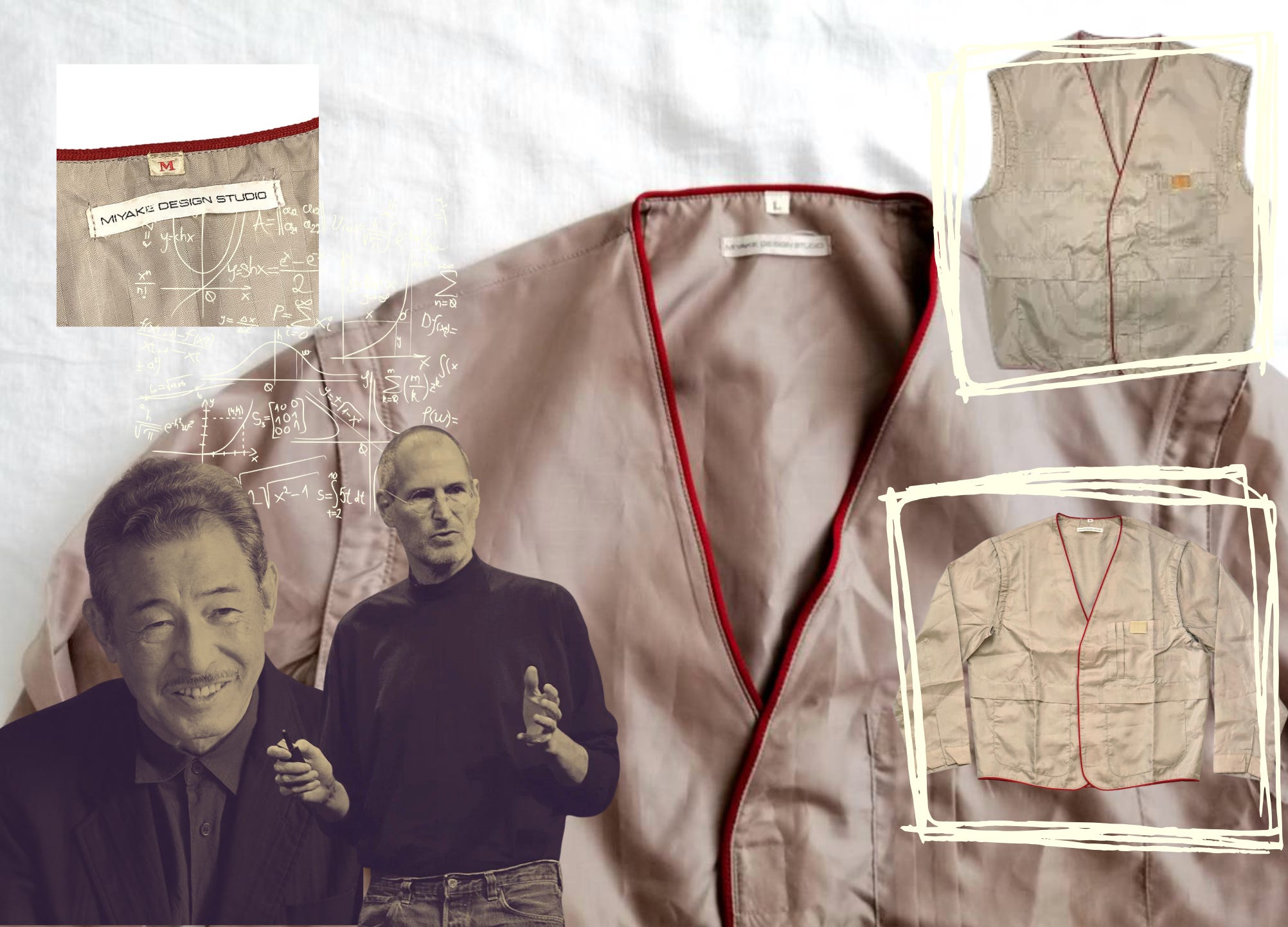
You may already know the story of how fashion and tech crossed paths here. Issey Miyake made Steve Jobs hundreds of his signature black turtleneck. But before that, Jobs had basically the same idea I’m having now about modularity, just aimed at his employees instead of menopausal women.
As the story goes, Jobs had seen the jacket Miyake designed for Sony, sleeves that unzipped to convert it into a vest, and wanted that same effect for Apple. He pitched a similar vest to his staff and got booed off the stage.
What stuck instead was that infamous turtleneck. I think that says something about what we’re really looking for here. Not more to configure, but instead something simple and resolved that doesn’t need managing.
Designing Software like Nature? Consider the Following
The modular, swap-the-parts logic Garuda borrows for clothing isn’t actually where software is headed anymore. It’s the old paradigm.
Almost every computer running today was built on something called von Neumann architecture, a design from the 1940s that keeps two things in separate places. One part does the thinking. A different part holds the memory. Every single action requires shuttling information back and forth between the two. Engineers have been working around that bottleneck for decades. Structurally, it’s the same idea as a zip-together vest. Separate, swappable components that have to communicate across a gap to function as one thing.
The most advanced chips being built right now skip that separation entirely. Modelled on the brain instead, where a single neuron handles thinking and memory at once. Companies like Intel and IBM are already deploying early versions, and the appeal is practical, less separation means less energy wasted, which means systems that adapt in real time instead of following fixed instructions.
So here’s the irony. Designing clothing like software, the modular, componentized, swappable approach, borrows from a paradigm software itself has already been leaving behind. The most advanced computing research has spent years moving toward nature’s logic. Clothing designed like software is catching up to an idea that computing already outgrew.

Miyake’s Conversation With the Body
Somewhere in all of this research I kept landing on Issey Miyake. I’d known about the pleating so synonymous with his name but the Apple connection made me look at it differently.
Pleats Please launched in 1993 and the construction process behind it is genuinely strange when you first hear it. The garment is cut and sewn at two to three times its final intended size, then sandwiched between sheets of paper and run through a heat press. The pleats are set after the garment already exists as a complete thing. What comes out the other side is permanently pleated, holds its shape through the washing machine, doesn’t need dry cleaning, can be rolled up and stuffed into a bag. But the more interesting part is what happens when you put it on. Because the pleats were set into an oversized structure, they expand and contract with the body wearing them without losing their form. The garment doesn’t yield to the body the way stretch fabric does, stretch is just a material that gives under pressure and springs back. This is different. The adaptability was engineered into the structure from the start, less like a feature, more like the base model itself.
Which is the same logic, I realized, as what the most advanced chip engineers are building now. Not separate parts passing information back and forth, but one structure where the function and the form are the same thing. Miyake got there in 1993 with a heat press.
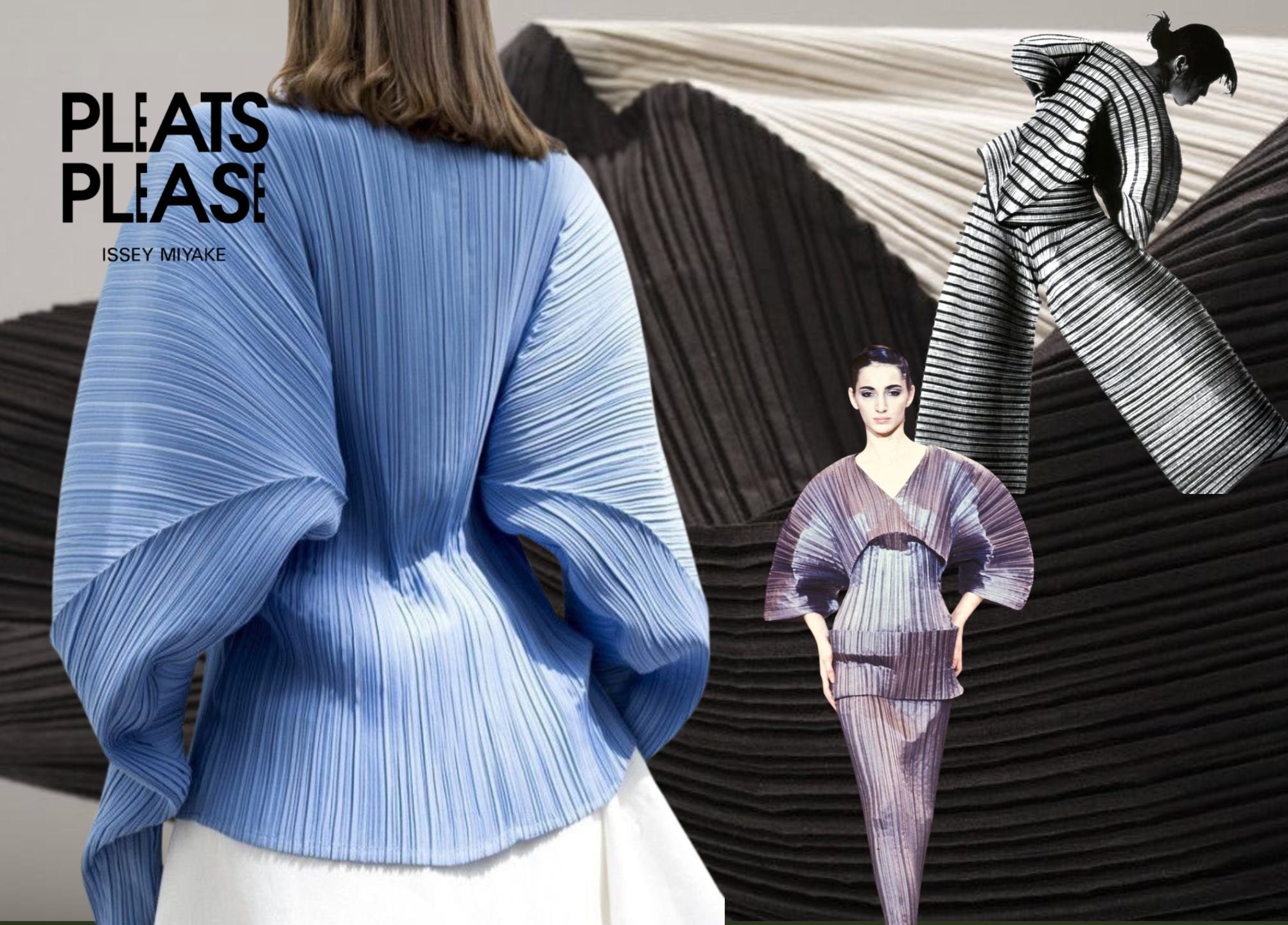
I found a piece on The Cut written by a trans woman who owns ten Pleats Please garments. She describes watching the fabric fold, billow and flatten on her body depending on how she moves, crosses her legs, shifts her weight. But what her mother said sounded familiar. When asked what drew her to Miyake’s designs, her mother answered: “The big thing for me was hiding my fat, middle-aged body behind those clothes. They tend to obscure your figure.” The writer calls it armour. Miyake’s empty space, the room the pleats create between the fabric and the body, dense and sturdy enough to shield her.
Miyake himself said: “The space created between the clothes and the body is what interests me and communicates the most.”
Not the garment as an object. The relationship between the garment and whoever is inside it.
The mother at the bridal shop wasn’t asking for much. Just a dress that would still be hers six months from now, on a body she couldn’t fully predict. What she needed wasn’t a tracking app or a cooling fabric or a vest with removable sleeves.
Fashion tech keeps building for the body as a fixed input, something to measure, track, optimize around. But the writer from The Cut, the one whose mother found armour in those pleats, put her finger on something the whole industry has been designing around rather than for:
“I might have certainties about my gender and body today, but that might change tomorrow — like Issey Miyake’s pleats, my body does not have definite forms. I put on Pleats Please garments to remind myself that I have the room to explore that.”
Thank you for making me learn something new about Issey Miyake. The whole piece was very interesting to read✨
looking forward to reading more from you ❣️ excellent food for thought.